
The vineyard & the team
In the garrigue of Provence, in the shadow of oaks and almond trees, vines have found their place since a long time. And men have taken great care of them.
This history continues with today’s team. Wine is a natural product, but it would not exist withou the women and men that make it.
Depending on the season and the agenda of the vine and the winery, we are between 3 and 15!
For more than 40 years, we have worked day in day out to bring the best of the terroir and reveal its distinctive character in our wines. Our six different varieties – Grenache, Syrah, Cabernet-Sauvignon, Cinsault, Rolle, Viognier – have established deep roots in our chalky clay soils which enjoy an ideal south-east orientation. Our whole vineyard is organic (Ecocert).
L’ensemble de notre vignoble est en agriculture biologique (Ecocert).
Our whole vineyard is organic (Ecocert). But we don’t stop there – we have a global approach of our vineyard in its environment.
We work with l’ADEME, Bio de Provence and the PACA Region. An in-depth technical analysis allows us to monitor the main indicators of biodiversity and to constantly improve our ecologic footprint.

Winemaking
Pruning is short and, if necessary, we control the volume produced (35 hl/hec) by removing the fruit early. The vines are cordon de Royat pruned, and trellised with two wires plus support wires.
Phytosanitary protection is provided by natural products (sulfur, Bordeaux mixture, etc.) applied after daily observation of our vines, in liaison with local winegrowers and departmental surveillance networks.
The vineyard has little exposure to traditional vine diseases. There is little or no leafhopper, grape berry moth or flavescence, no black rot, and rarely any downy mildew or gray mold. On the other hand, powdery mildew pressure is fairly high, but our vigilance is enough to cope.
We fight against wood diseases, mainly esca, by prophylaxis: we remove and burn dead wood, disinfect cutting tools and pruning wounds, and replace dead vines. Every year we lose several hundred vines to this cause. Details on Esca here
We take great care in tilling the soil to maintain its vitality. We do not use weedkillers. Depending on the year and the plot, we alternate between controlled grassing and ploughing. Soil improvement is always carried out using organic products measured out on the basis of soil analysis, so as to apply only what is necessary. Dry years can cause the vines to suffer from water stress. Thanks to their 35-year-old root system, deeply rooted in living soil, our vines have learned to find hidden pockets of moisture in the heart of the soil, and are highly resistant to stress.

Winemaking
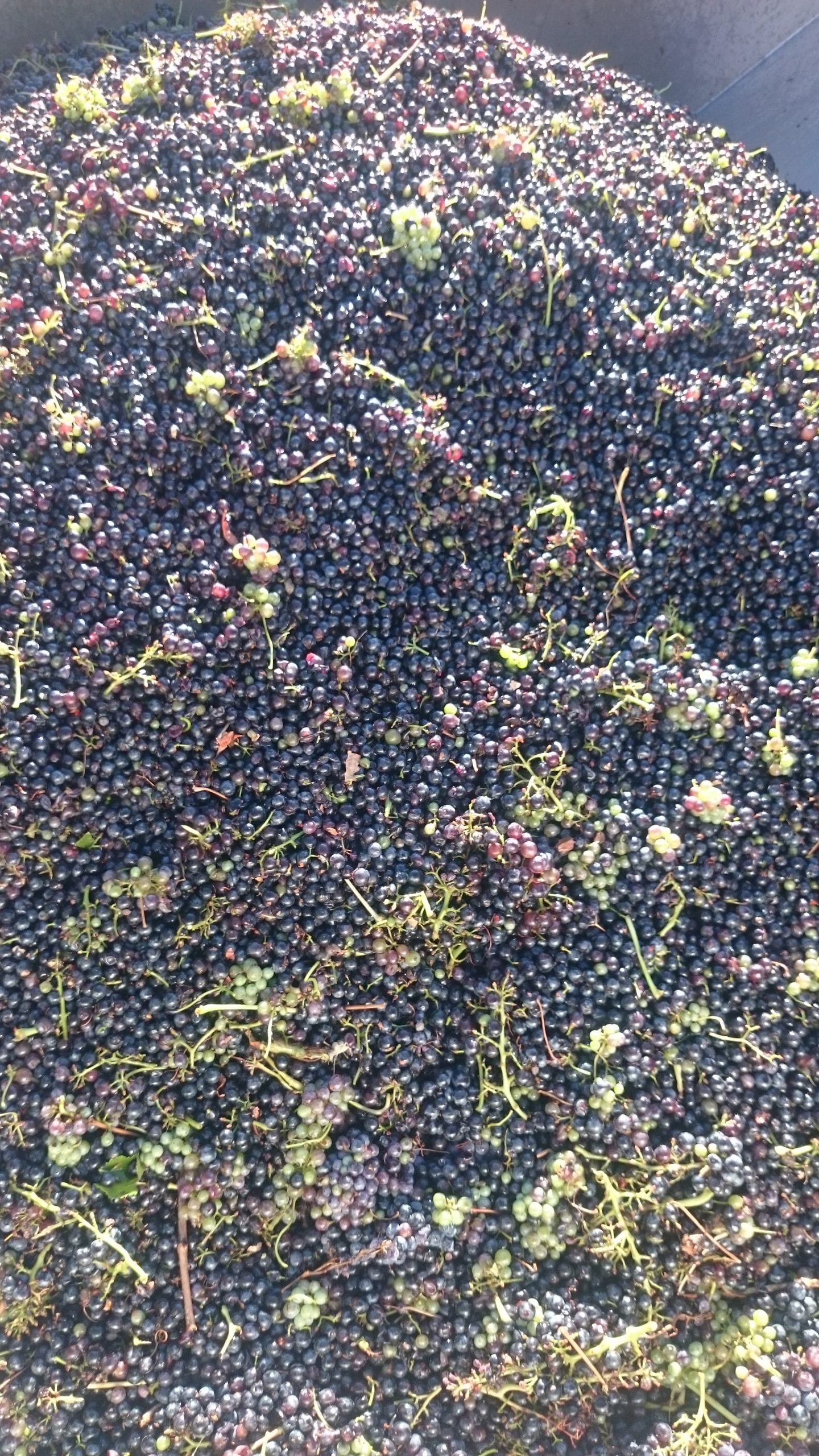
We harvest partly manually and partly by machine. From the vineyard to the winery, the grape never takes more than 10 minutes, the best protection against oxidation. We harvest at optimum phenolic maturity.
Good organization and the small size of our vineyard allow us to harvest our grapes within a very short time if necessary in order to perfectly take into account meteorologic constraints. Some fields are harvested in several times in order to only choose perfectly mature grapes.
Some fields are harvested in several times in order to only choose perfectly mature grapes. Red winemaking is done with the utmost respect for the grape quality.
Rosé is produced by very light pressing (0.2 bar), as this has proved to be the method that best preserves the authenticity and freshness of the berry flavors. It finishes its fermentation in a vat, separated from the pomace of the harvest. It is composed of Cinsault, supported by Grenache.
The whites are produced after cold skin maceration, pressing and settling by fermentation started cold in vats or stave oak barrels (demi-muids) depending on the characteristics of the year. They are aged on lees with stirring and do not undergo malolactic fermentation.
For our red and white wines, we always renew our barrels with the aim of enhancing the expression of our terroir, not extracting wood juice. We don’t want our customers to get splinters from drinking our wines!
Curious and passionate, we are constantly striving to improve our wines. By deepening the expression of the wines we regularly produce (Champ de la Truffière, Champ du Sesterce…) or by producing cuvées that are the fruit of the particularities of a vintage (Marie Liesse, Pointes, Rosé des filles…).
The beginning of the adventure…
The Domaine du Deffends has existed since ancient times; one can find the ruins of a Gallo-Romaine farm (stones, broken bottles, pottery…), once we even found a sesterce (roman coin), but the activity was no doubt essentially consecrated to olive trees and cereals.
When Jacques de Lanversin acquired it in 1963, it had long since been abandoned apart from a brief occupation during the war by “les Chantiers de Jeunesse,” a French paramilitary organisation of the time. His plan was to cultivate the land (approx. 14 hectares) as it had been previously, and given the nature of the chalky clay soil, he thought it would be perfect for grapevines. He was not yet thinking of making wine, but of growing a grape capable of producing a quality wine.
With this aim, he planted, at first, Grenache and Cinsault and then, after having seen at close hand the experimentation carried out in Rians by the former owner of Château la Lagune, Georges Brunet, he choose to add Syrah and Cabernet-Sauvignon to constitute the base of a “vin de garde.” That was the way he set it up. However, Jacques’ initial idea to sell on his grapes based on their quality was scuppered by a new law passed in Paris. The “degré/hectolitre” law made it, for one reason or another, economically impossible.
He tried to find ways around the legislation, but, in the end, was left with a stark choice; rip out the vines and sow cereal to limit the maintenance costs or, go all the way with the vines, build a cellar and make the wine himself. Thankfully Jacques went for broke and opted for the latter. Then, when his earlier gamble that this stony and visibly arid soil could produce the goods proved to be true, he was on his way and it was not long before the quality of the wines were duly recognised. In 1995, the arrival of the Canal de Provance saw the Saint Maximin plain, which had at one time been dedicated entirely to grapevines, convert to polyculture. From the three wine co-operatives that were part and parcel of village life, only one remains, l’Amicale. Only four private producers are left; Domaine de Saint Jean le Vieux, Vignoble Arnaud, Domaine Saint Mitre, Domaine de la Batelière. As in many places, the last 20 years have been hard on local agriculture and the village way of life.